Physician-Led Research for Cognitive Diagnostics
BrainTest was an empirically validated app for early Alzheimer's screening — available to clinics, doctors, and directly to families who wanted the option of screening at home. The premise was to make early detection more accessible, moving it beyond the clinic and into everyday life.
I joined the project mid-stream, working across iOS, Android, and web to help shape both the patient and doctor-facing experiences. My work covered UI and UX design, prototyping, design system, animations, onboarding flows, and QA.
The Problem
Alzheimer's screening had traditionally lived in clinical settings — paper-based, inconsistent, and out of reach for most families. BrainTest set out to change that by digitizing a validated screening tool and making it available both through doctors and directly to consumers.
The design challenge was broad. The primary audience — seniors and their families — needed an experience that was clear, reassuring, and easy to navigate. Doctors and researchers needed a parallel set of tools that gave them efficiency, flexibility, and clinical reliability. And both sides needed to feel like they belonged to the same product.
Working across two audiences
The product served two very different users: families navigating a sensitive and often frightening topic, and clinicians who needed reliable data and research tools. I worked on both sides — designing patient-facing flows (signup, screening, results) alongside the doctor portal with its scoring, research features, and clinic-specific configurations.
Design system
When I joined, different designers had been working across files with inconsistent components, naming conventions, and styling. I helped audit the existing work and build out a centralized design library that standardized elements across iOS, Android, and web. It wasn't glamorous work, but it meaningfully reduced handoff errors and gave the team a shared foundation to build from.
Designing for seniors
Accessibility wasn't an afterthought here — it was central to every decision. Large typography, high-contrast color choices, simplified flows, and minimal cognitive load at each step. Usability testing with seniors confirmed what the research suggested: fewer steps, stronger contrast, and clear visual hierarchy made a significant difference in whether people could complete the screening confidently.
Onboarding and animation
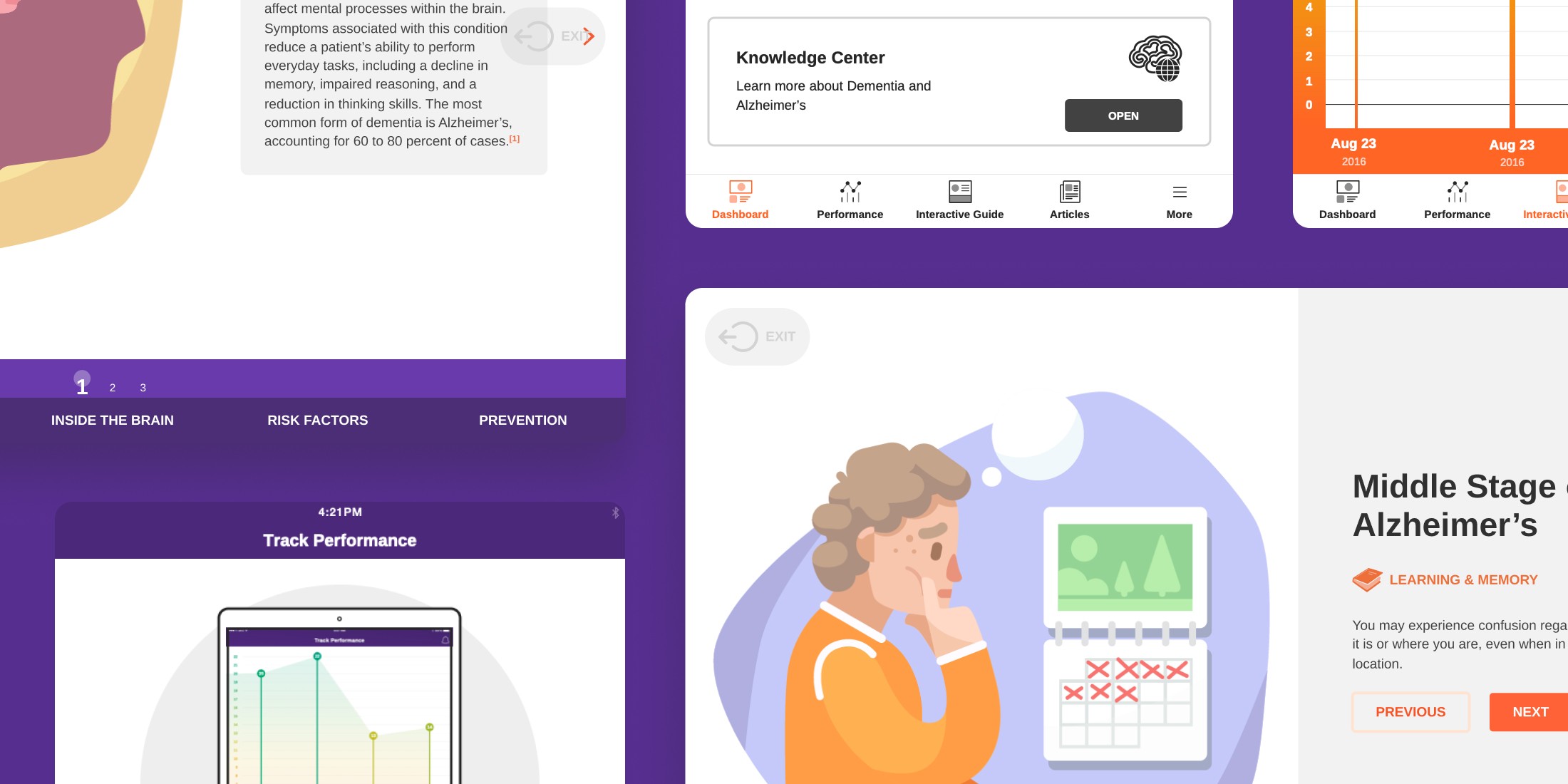
Most families preferred visual guidance over reading through instructions. I designed tutorial videos and micro-animations using After Effects and Lottie to walk users through the screening process in a way that felt approachable rather than clinical.
Interactive Guide
Alzheimer's is an overwhelming subject for families. Beyond the screening itself, I designed an interactive educational guide — illustrated scenarios, quiz-style interactions, and lightweight animations — to give families context, reassurance, and a sense of what to do next. Stakeholders flagged it as one of the features that set BrainTest apart from competitors.
Outcome
BrainTest launched publicly across iOS, Android, and web, serving both clinical and consumer audiences. The design system improved consistency across platforms and reduced the back-and-forth during development handoff. The Interactive Guide became a meaningful part of the product — not just a supplement to the test, but something families returned to independently.
The app is still available on the App Store and Google Play. Whether it's actively maintained today isn't something I can speak to, but it reached a point where doctors could run research studies through it, families could screen at home, and the clinical and consumer experiences felt cohesive.
Reflection
Designing for a sensitive health topic taught me that tone is a design decision. Every color, every label, every animation either adds to someone's anxiety or reduces it — especially when the subject is something as personal as cognitive decline. That awareness has stuck with me.
Working across two very different user groups on the same product also sharpened how I think about scope. Patient needs and doctor needs overlapped in some areas and pulled in completely different directions in others — learning to hold both clearly was a big part of navigating this project well.